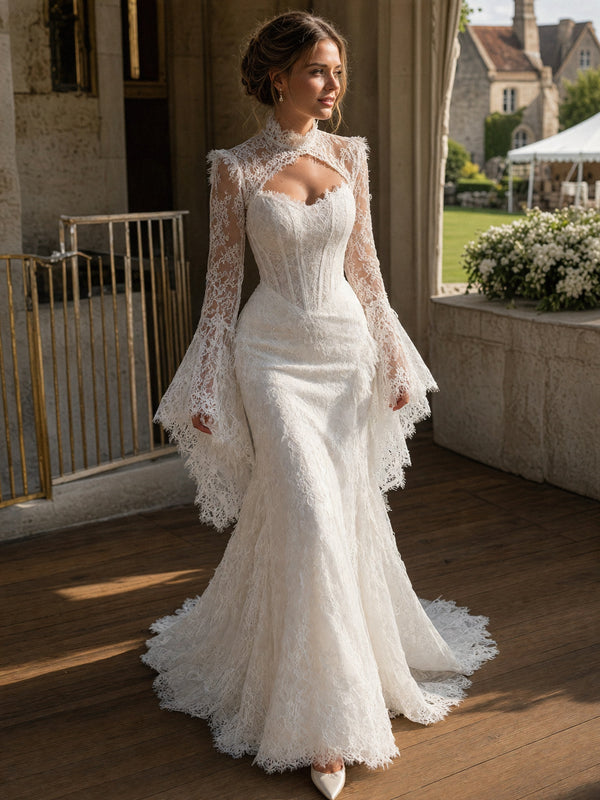
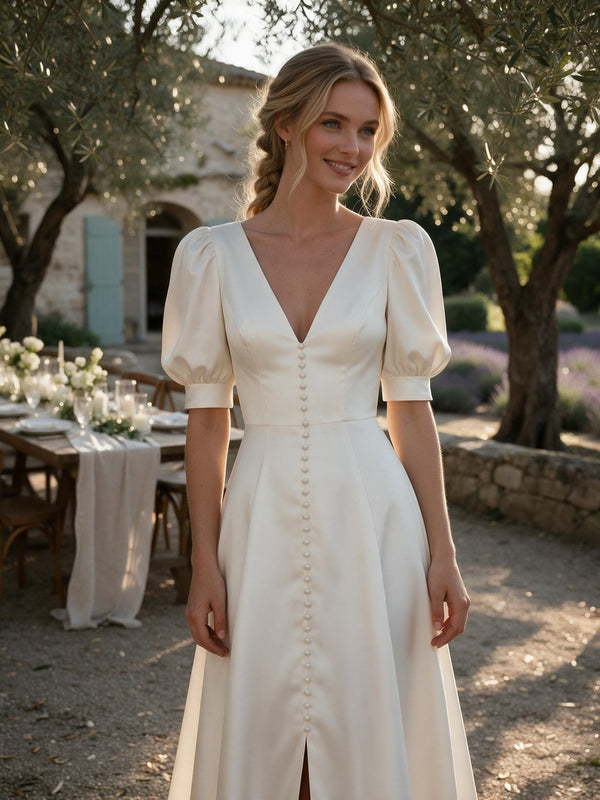
Tulle is the fabric most people picture when they think of a wedding dress: the cloud of a ball gown, the veil, the skirt that floats as you walk down the aisle. It is a fine net, so light that it takes ten or twenty layers to make a full skirt, and yet those layers weigh less than a single layer of satin. Today tulle comes soft or crisp, plain or glittering, pleated, embroidered or scattered with lace. Here is how to tell them apart, which silhouette each one makes, and how to choose your tulle wedding dress.
- Tulle is a fine net: light, airy, and built up in layers for volume.
- Soft tulle drapes and floats; stiff tulle holds a full shape.
- Glitter tulle is woven with a fine shimmer; it sparkles without sequins.
- Tulle suits every season: layered for winter, single and flowing for summer.
- What tulle is
- The tulle styles
- Tulle by silhouette
- Tulle, organza or chiffon?
- Practical tips for a tulle dress
- Our selection
- Your questions
What tulle is
Tulle is a very fine net with small, regular openings, usually in polyamide, polyester or silk. Because it is mostly air, it is transparent in one layer and becomes softly opaque as the layers pile up. That is its magic: the more layers, the fuller and whiter the skirt, without the weight of a heavy fabric.
Two families matter for a wedding dress. Soft tulle, sometimes called illusion tulle, falls and drapes: it makes flowing A-lines, sheer sleeves and illusion necklines that disappear on the skin. Stiffer tulle holds its shape: it is the one under a ball gown, often hidden beneath softer layers, that keeps the skirt round all day.
The tulle styles
| Tulle | How it looks | The effect | Best for |
|---|---|---|---|
| Soft tulle | Fine, fluid, several light layers | Airy and romantic | A-lines, garden weddings |
| Glitter tulle | Tulle with a fine woven shimmer | Sparkles in every light, softly | An evening ceremony, a winter wedding |
| Pleated tulle | Tulle gathered in fine pleats on the bodice | Texture without embroidery | A strapless sweetheart bodice |
| Embroidered tulle | Lace or beaded appliqués on tulle | Detail that seems to float on the skin | Sheer sleeves, illusion backs |
| Illusion tulle | Sheer, skin-toned panels | Covers without hiding | High necklines, covered backs |
| Layered tulle | Many layers, sometimes over a shimmer underskirt | Volume and depth | Ball gowns, cathedral trains |
Tulle is often paired with other fabrics: a satin bow, a lace corset, a chiffon overlay. Our guides to lace and satin explain what each one adds.
Tulle by silhouette
Ball gown
Tulle is the classic fabric of the ball gown: many layers over a stiffer base, for a round skirt that holds all day. See our ball gown guide.
A-line
Soft tulle in fewer layers falls straight from the waist: lighter, easier to walk and dance in, and flattering on every figure.
Tea length and short
A full tulle skirt stopping at mid-calf has a 1950s grace; a short tulle skirt is playful for a city hall ceremony.

Tulle, organza or chiffon?
| Fabric | Feel | Shape | Choose it for |
|---|---|---|---|
| Tulle | Net, very light, slightly textured | Volume through layers | A floating skirt, sheer sleeves |
| Organza | Smooth, crisp, with a sheen | Holds sculpted shapes | Structured sleeves, bows, ruffles |
| Chiffon | Matte, soft, flowing | Drapes close to the body | A beach or garden wedding, a light A-line |
Tulle is the most versatile of the three: it can be a cloud or a whisper, depending on how many layers are used.
Practical tips for a tulle dress
- Tulle creases little, but steam it gently on the day, never iron it directly.
- Avoid Velcro, rough stone and bramble: fine net can snag.
- For a long train, plan a bustle for the reception.
- Layered tulle is warm enough for winter; a single layer stays cool in summer.
- Glitter tulle sparkles most at night: think of your evening photos.
- Sit down at the fitting: the skirt should spread without crushing.
With a full tulle skirt, the hem length matters more than anything: too long and you step on the layers, too short and the volume looks unfinished. Our dresses are cut from your measurements, including the hollow-to-floor length taken in your shoes; follow our guide on how to measure.
For the train itself, read our guide to wedding dress trains.
Our selection
Six tulle dresses, from soft layers to glitter and pleats. All are made to your measurements or in your standard size.
 BazochesOversized satin bow, beaded corset, layered tulleSee the dress →
 VertusPlunging illusion neckline, lace-leaf sleevesSee the dress →
 TurckheimSoft tulle, detachable sheer puff sleevesSee the dress →
 CrozesPleated tulle bodice, puff sleeves, high slitSee the dress →
 MontlouisGlitter tulle, lace corset, bishop sleevesSee the dress →
 RiquewihrGlitter tulle, floor-length tulle streamersSee the dress →
Your questions
Is a tulle wedding dress heavy?
No. Tulle is one of the lightest bridal fabrics. Even a very full skirt made of many layers usually weighs less than a satin skirt of the same volume.
Does tulle crease?
Very little. Hang the dress as soon as it arrives and steam it gently from a distance if needed. Never put a hot iron directly on tulle.
Is tulle suitable for a summer wedding?
Yes. Choose soft tulle in fewer layers and an A-line rather than a full ball gown: it stays light and lets the air through.
What is the difference between tulle and organza?
Tulle is a net, airy and slightly textured, that builds volume through layers. Organza is a smooth, crisp woven fabric with a sheen that holds sculpted shapes.
What is glitter tulle?
A tulle woven with a fine shimmer. It sparkles softly in the light without the weight or the flash of sequins.
Can a tulle dress be worn in church?
Of course. Tulle sheer sleeves or an illusion neckline cover the arms and shoulders lightly; for a strapless dress, add a bolero or a cape for the ceremony. See our church dress code guide.