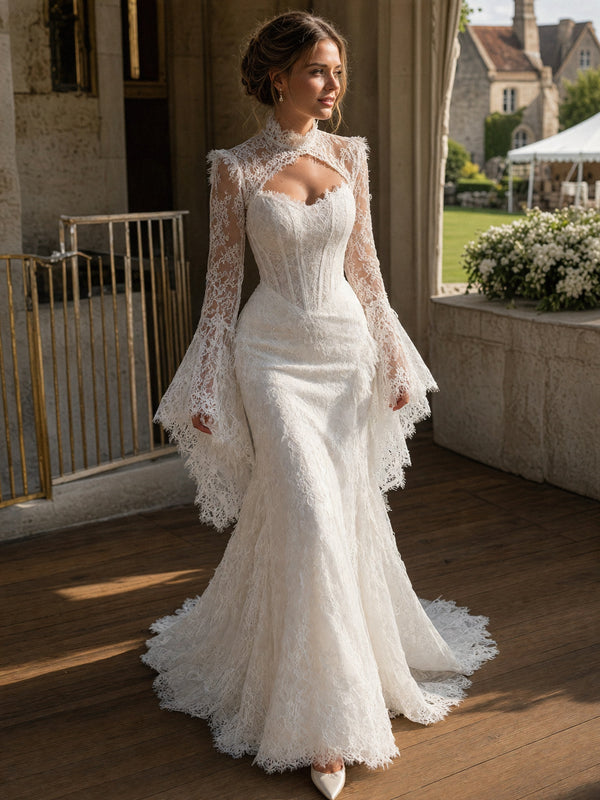
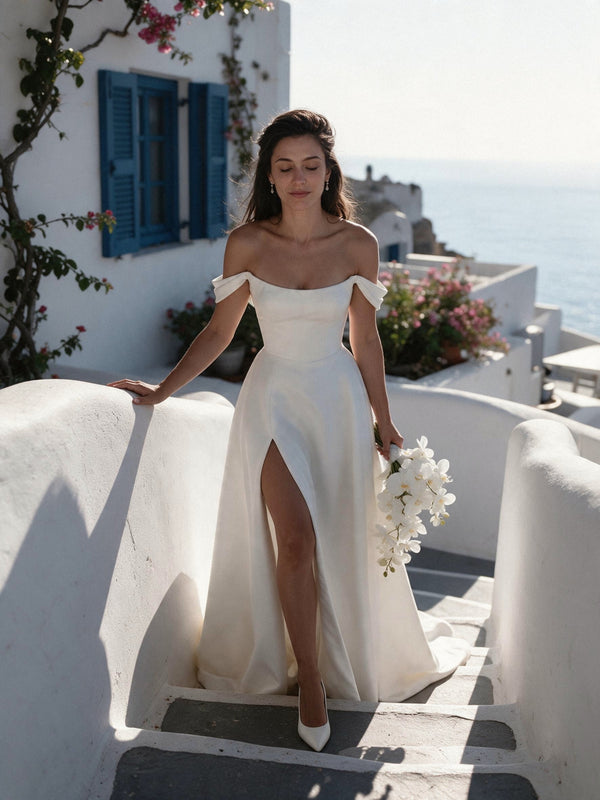
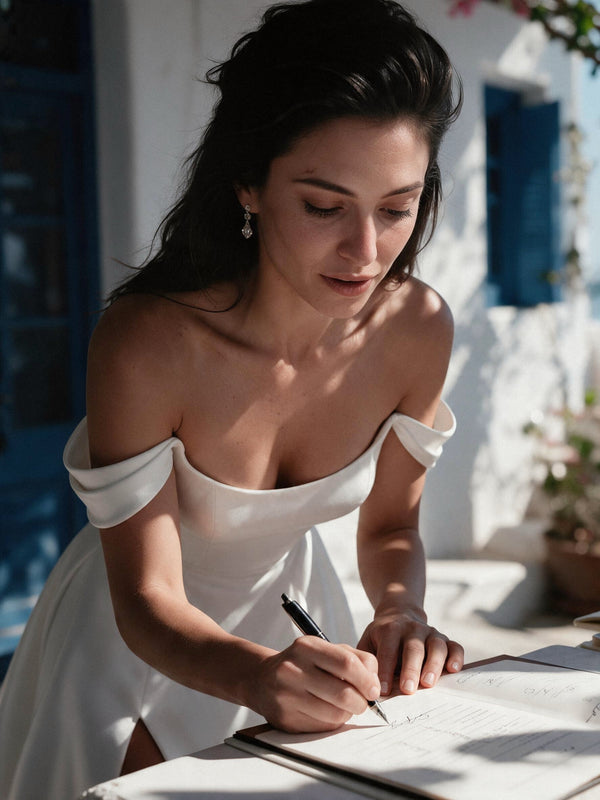
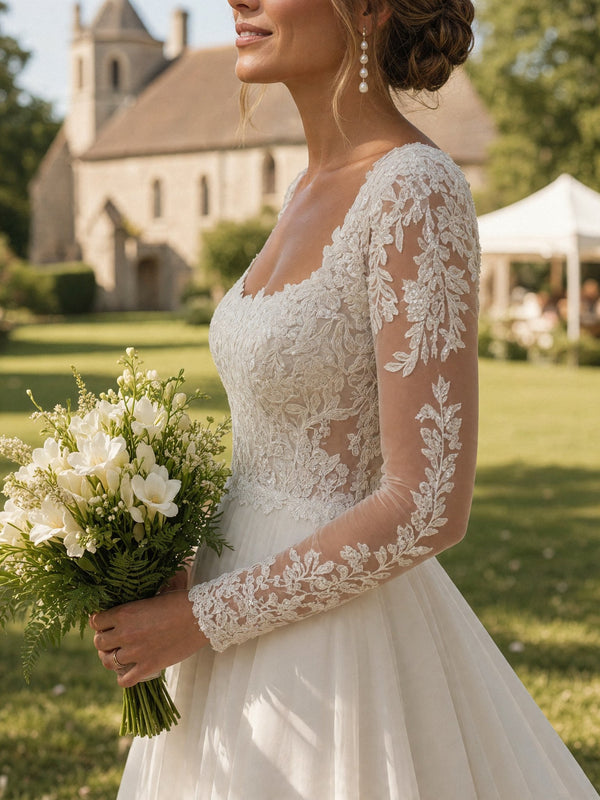
Close your eyes and picture a wedding dress, and chances are it is an A-line. A fitted bodice, then a skirt that flares gently to the floor, like the letter A. Not too much volume, not too close to the body: it is the most worn bridal silhouette, and for good reason. It suits almost every figure, almost every venue, and comes in every fabric.
- An A-line dress is fitted at the bodice and flares gradually to the hem.
- It sits between the ball gown, fuller, and the sheath, closer to the body.
- It defines the waist and skims the hips: flattering on almost every figure.
- The fabric changes everything: crisp satin, fluid crepe, airy organza or romantic lace.
- What is an A-line dress?
- Why it suits everyone
- Fabric changes everything
- Neckline, sleeves, train
- By venue
- Our selection
- Your questions
What is an A-line dress?
An A-line dress is fitted through the bodice, then widens in a straight line, with no sudden break, down to the floor. What sets it apart from its two neighbours is the amount of volume.
| Silhouette | The skirt | Volume | The look |
|---|---|---|---|
| A-line | Flares in a straight line from the bodice | Moderate | Timeless, easy |
| Ball gown | Starts from a defined waist, very full | High | Spectacular, fairytale |
| Sheath | Falls straight, close to the body | Low | Minimalist, modern |
| Mermaid | Fitted to the knee, then flared | At the hem only | Glamorous, sensual |
To compare every cut, see our wedding dress silhouettes guide.
Why it suits everyone
It defines the waist
The fitted bodice draws the waist, the narrowest point of the silhouette.
It frees the hips
The skirt moves away from the body without clinging: hips and tummy are skimmed, never emphasised.
It lengthens
The continuous line from bodice to hem stretches the silhouette, especially with a V neckline.
Hourglass, pear, apple or straight: the A-line adapts, through the neckline and the fabric. Our guide to the wedding dress for your body shape covers each case, and our plus-size guide the right reflexes.

Fabric changes everything
The same A-line cut can be sculptural or airy depending on the fabric. It is often the fabric that decides the style of the dress.
| Fabric | The drape | The effect | For whom |
|---|---|---|---|
| Satin, mikado | Firm, structured | Crisp, architectural | Minimalist brides |
| Crepe | Fluid, matte | Modern, clean | City weddings |
| Organza | Light, airy | Ethereal, luminous | Daytime weddings |
| Glitter tulle | Floaty | Sparkling | Evening weddings |
| Lace | Supple | Romantic, couture | Church, garden, château |
To go further: our guides to satin, lace and sparkly wedding dresses.
Neckline, sleeves, train
On an A-line, the neckline sets the character:
- V neckline: lengthens the torso, ideal for petite brides and fuller busts.
- Strapless or sweetheart: frees the shoulders, very romantic in lace.
- Square or portrait neckline: graphic and chic, perfect in satin or mikado.
- High neck and long sleeves: covered and elegant, for church or winter. See our long-sleeve wedding dress guide.
As for the train, the A-line takes anything from a sweep train to a cathedral train. The longer it is, the more you need a bustle for the party.
A great A-line is all in the bodice: if it gapes, the whole line collapses. Our dresses are cut from your measurements; follow our guide on how to measure for a made-to-measure dress.
By venue
An A-line does not choose your wedding for you: it adapts to it.
- Church or cathedral: lace, sleeves, a chapel train.
- Château or estate: satin, mikado, a long train.
- Garden or countryside: organza, chiffon, a hem that brushes the ground.
- City town hall: crepe or matte satin, a clean line, a short train.
Our selection
Six A-line dresses, from clean mikado to glittering tulle, made to your measurements or in your standard size.
 MarsannayMikado, portrait collar, minimalist lineSee the dress →
 RullyCrepe, eyelash lace square neck, sheer lace panelSee the dress →
 GigondasStrapless Chantilly lace, scalloped hemSee the dress →
 GivryMatte satin, plunging V, pleated skirtSee the dress →
 BourgueilOrganza, high neck, bishop sleevesSee the dress →
 AmpuisGlitter tulle and lace, pearl straps, high slitSee the dress →
Your questions
What is the difference between an A-line and a ball gown?
An A-line flares gently, in a straight line from the bodice or waist. A ball gown starts from a defined waist into a much fuller skirt, often held out by a petticoat. See our ball gown guide.
Do A-line wedding dresses suit curvy brides?
Yes, it is one of the most flattering cuts: it defines the waist and skims the hips without clinging. Our plus-size wedding dress guide covers the best choices.
Do A-line wedding dresses suit petite brides?
Yes. Choose a fluid skirt rather than a very full one, a slightly raised waist or a V neckline that lengthens the torso, and a short train.
Which fabric is best for an A-line dress?
They all work: satin and mikado for a clean line, crepe for fluidity, organza and tulle for lightness, lace for romance. The table above sums up their effects.
Is it easy to dance in an A-line dress?
Yes, it is one of the most comfortable dresses: the skirt leaves the legs free. If the train is long, plan a bustle (buttons or ribbons) for the party.
A-line or sheath for a town hall wedding?
Both work. The A-line is more formal, the sheath more minimalist. Our civil wedding dress guide helps you decide.
More than one hundred and sixty A-line wedding dresses, cut to your measurements.
See A-line wedding dresses