Some dresses you look at; others you want to touch. Lace belongs to the second kind: it covers and reveals at the same time, catches the light, and reads beautifully in photographs, up close and from afar. The question is which lace, because between an almost transparent Chantilly and a sculpted guipure lies a whole world.
- Chantilly: fine, soft and airy, ideal for sleeves, veils and summer.
- Alençon and corded laces: raised motifs, with enough body to carry beading.
- Guipure: no net ground, graphic and heavier, perfect for spring, autumn and a boho look.
- Eyelash lace: its fringed edges soften a neckline, a sleeve or a hem.
- Choose your lace for your silhouette, your season and your veil, and protect it from snags on the day.
- Why lace never goes out of style
- The laces to know
- Calais, Caudry, Alençon: French lace
- Which lace for which silhouette
- Lace and the seasons
- The details that make the difference
- Our selection
- Veil, bolero, gloves: matching your lace
- Caring for a lace wedding dress
- Your questions
Why lace never goes out of style
Lace has the rare quality of being both romantic and modest. Laid over a skin-tone tulle, it dresses the shoulders and arms without hiding them; used on its own, it draws a pattern that needs nothing else. It is also a forgiving fabric: its texture hides the small creases of a long day and catches the light from every angle, in full sun as by candlelight.
It suits every silhouette, too. A ball gown may carry lace only on the bodice, a mermaid dress can be covered in it from neckline to train, a tea-length sheath can be cut from a single piece of guipure. So the question is not whether lace will suit you, but which one.
The laces to know
In bridal shops, lace names usually describe a style rather than a place of origin: "Alençon lace" sold by the metre is almost always a machine lace inspired by the original. Here is how to tell them apart by eye.
| Lace | How to recognise it | Its character | Best for |
|---|---|---|---|
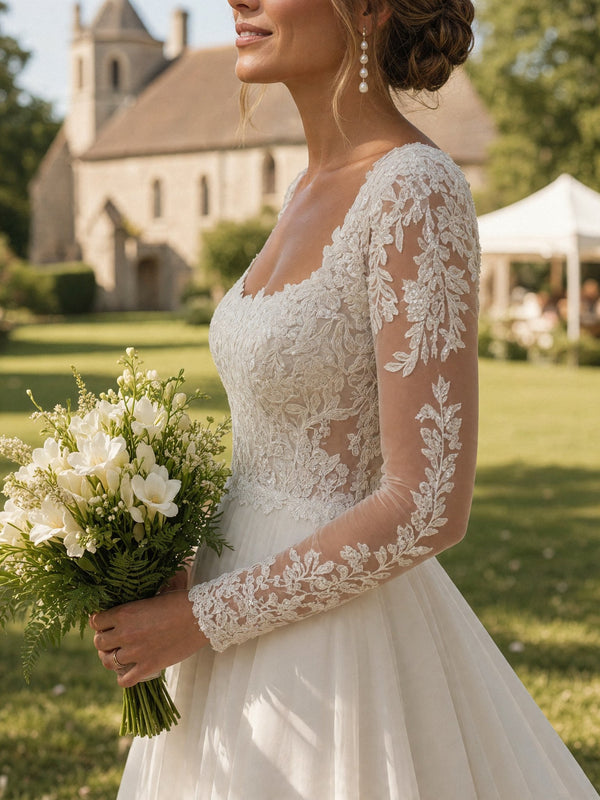
| Chantilly | Very fine net ground, delicate floral motifs outlined with a flat thread | Light, soft, almost sheer | Sleeves, backs, veils and mantillas, summer weddings |
| Alençon | Motifs edged with a cordonnet, a thicker thread that creates relief | Structured, precious, holds beading | Embroidered bodices, appliqués, ball gowns |
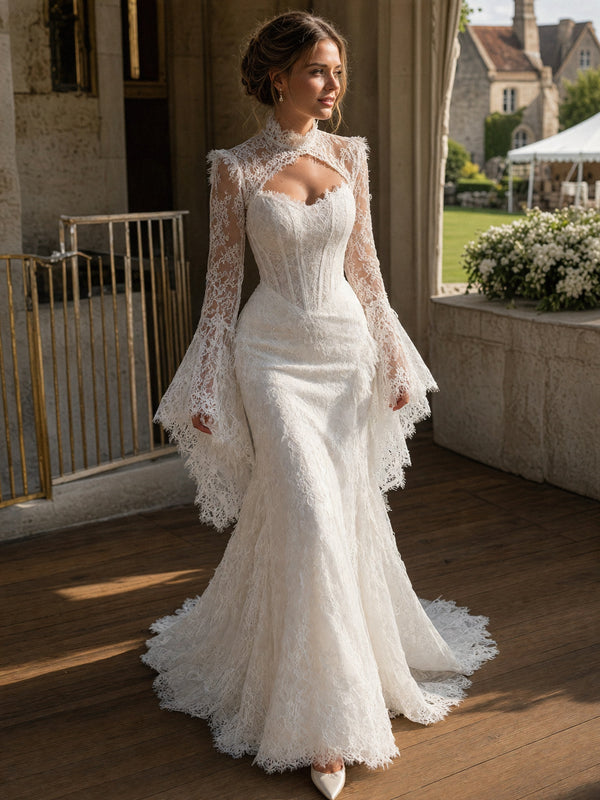
| Corded lace | Motif outlines re-embroidered with cord, a sculpted look | Graphic, luminous, with body | Mermaid dresses, high necks, sleeves |
| Guipure | No net ground: the motifs are joined by small bars | Heavier, open, very graphic | Sheaths, tea-length dresses, boho style, spring and autumn |
| Eyelash lace | Edges fringed with loose threads, like eyelashes | Romantic, soft, slightly vintage | Necklines, bardot bands, sleeve hems |
| 3D lace | Flowers or leaves cut out and applied in relief | Spectacular, poetic | Bodices, trains, evening looks |
A single dress often mixes several: a corded lace bodice, Chantilly sleeves, an eyelash hem. That layering is exactly what makes the finest pieces so rich.

Calais, Caudry, Alençon: French lace
France holds a special place in the history of lace. In Alençon, Normandy, the needle lace known as "point d'Alençon" is such a demanding craft that UNESCO inscribed it in 2010 on the Representative List of the Intangible Cultural Heritage of Humanity. The work is so meticulous that a single motif can take a lacemaker many hours.
In the north, Calais and Caudry built their reputation on machine lace woven on Leavers looms, machines born in England in the nineteenth century and brought to the region. The collective trademark Dentelle de Calais, registered in 1958 and since extended to Caudry, identifies the lace made there. Lace from Caudry was famously chosen for Kate Middleton's wedding dress in 2011.
Lace does not have to be handmade to be beautiful: what matters is the fineness of the ground, the crispness of the motifs and the way the dress is put together. Look closely at the pattern matching at the seams and at the scalloped edges: that is where quality shows.
Which lace for which silhouette
Ball gown and A-line
Lace often gathers on the bodice and scatters across a tulle skirt. Alençon-style or beaded lace adds relief without weighing the skirt down.
Mermaid and sheath
Here the lace follows the body: choose lace set on stretch tulle or well lined, with motifs that follow the curve of the hips.
Boho and tea-length
Guipure and geometric laces have enough body for a short skirt or a sheath, and a natural charm made for the countryside.
To go further on cuts, our guide to wedding dress silhouettes and the one on the right dress for your body shape explain every shape.
Lace and the seasons
Lace works all year round, but not every lace in the same way. In summer, Chantilly or a fine lace on tulle lets the skin breathe; a light lining and sheer sleeves keep you cool. In autumn and winter, guipure, corded lace and long sleeves come into their own, with a cape or a bolero for the church steps.
Colour matters too: ivory lace over a nude or champagne lining makes the motifs stand out, while white lace on white gives a more graphic effect. Our guide to ivory, white or champagne will help you decide.
The details that make the difference
- Scallops: a scalloped hem or neckline follows the natural edge of the lace, with no visible seam.
- Pattern matching: on a beautiful dress, motifs flow from one panel to the next.
- The back: covered buttons, lacing, or an illusion back edged with lace.
- The sleeves: long in Chantilly, bell-shaped, or detachable for the evening.
- The train: a lace border on tulle is enough to make it spectacular.
- The weight: an all-guipure dress weighs more than an embroidered tulle one.
Lace hides nothing: it chooses what to show.
Our selection
Six dresses, six laces, each made to your measurements or in your standard size.
 BouilhPearl-dotted Chantilly lace, square neck, long sleevesSee the dress →
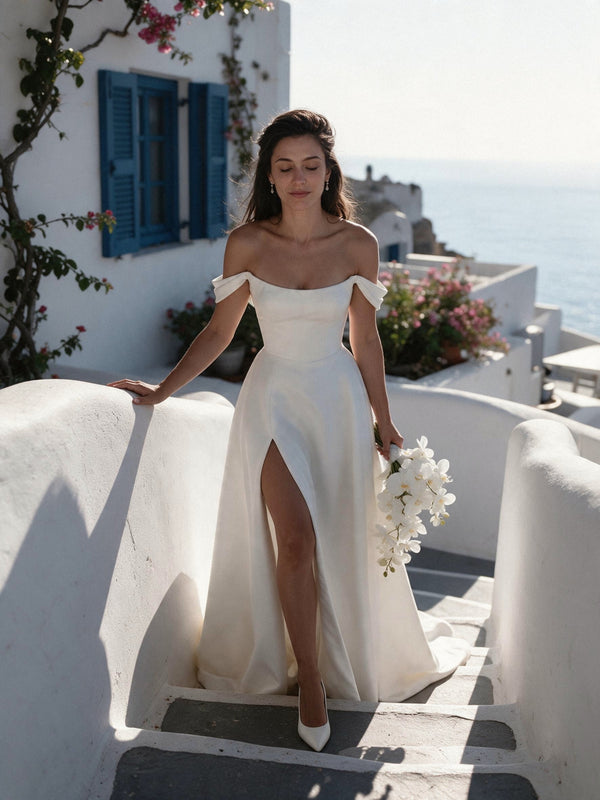
 MareuilGuipure lace, boned corset, off the shoulder, chapel trainSee the dress →
 Port-VendresCorded lace, high neck, mermaid, flared cuffsSee the dress →
 VerzenayEyelash lace, folded lace band, chapel trainSee the dress →
 ChouillyLace A-line, off the shoulder, scalloped hemSee the dress →
 TrébéronTea-length guipure pencil dress, strapless, back slitSee the dress →
Veil, bolero, gloves: matching your lace
The golden rule is simple: one strong lace at a time. If your dress is heavily worked, choose a plain tulle veil or one with a fine edge; if it is pared back, a lace mantilla or bolero can become the star. Match the colour and the scale of the motifs, too: a delicate Chantilly sits awkwardly next to a heavy guipure. For the length of your veil, see our veil length guide.
 Rose lace mantillaRose lace border, white or blackSee the mantilla →
 High neck lace boleroHigh neck, full lace sleevesSee the bolero →
 Eyelash lace glovesShort, handmade, whiteSee the gloves →
Caring for a lace wedding dress
Lace is sturdier than it looks, but it has one enemy: snags. On the day, watch out for claw-set jewellery, bracelets, the wire in a bouquet and the Velcro on a bag. To remove creases, use a garment steamer held at a distance, from the inside, never an iron pressed directly onto the motifs. After the wedding, take the dress to a specialist cleaner, then store it flat or on a padded hanger, in a breathable cotton bag with acid-free tissue paper, away from the light.
Your questions
Is a lace wedding dress suitable for a summer wedding?
Yes, as long as you choose a fine lace set on tulle, such as Chantilly, and a light lining. Heavier laces like guipure or corded lace are warmer, so keep them for spring, autumn and winter.
What is the difference between Chantilly and Alençon lace?
Chantilly is a very fine lace on a delicate net ground, with floral motifs lightly outlined: it is soft and airy. Alençon is recognised by its cordonnet, a thicker thread that outlines each motif and gives it relief; it has more body and holds beading well.
Does lace wrinkle?
Far less than satin or chiffon: its texture hides small creases. It is mostly the lining and the tulle of the skirt that need a gentle steam, from the inside, the day before the wedding.
Can a lace wedding dress be made to measure?
Yes. At Serment, every dress can be cut from your five measurements, lace included. Our guide on how to measure yourself walks you through each step.
Which lace is the most expensive?
Handmade laces, worked with a needle or on bobbins, are by far the rarest and most costly, because a small piece can take a great many hours. Quality machine laces, such as those woven on Leavers looms, come just below.
Which veil goes with a lace wedding dress?
A plain tulle veil leaves all the attention on the lace of the dress. If you love the idea of a mantilla, choose a finer lace edge, or one close to the lace of your dress, so the two do not compete.
More than three hundred lace wedding dresses, cut to your measurements.
See lace wedding dresses