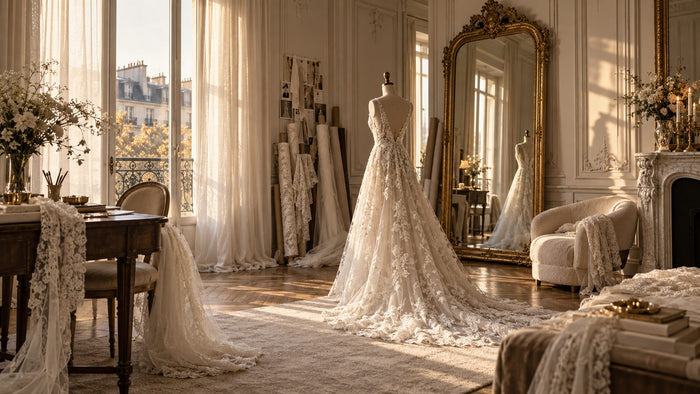

White, ivory, champagne: in a shop window they look almost the same, and next to your face they look nothing alike. The colour of a wedding dress changes how the lace reads, how your skin looks in the photographs and how the veil sits beside it. Here is how the shades really differ, how to find the one that suits you, and how to match everything you wear with it.
The shades of white, side by side
Bridal houses do not all use the same names, so read these as families rather than exact codes.
- White (or bright white). The purest, coolest shade, with no warmth at all. In strong daylight it can look almost blue. It gives the crispest contrast against a dark suit.
- Soft white, off-white or diamond white. A white with the edge taken off. Still clearly white, a little gentler on the skin.
- Ivory. White with a touch of cream. It is one of the most chosen shades in bridal wear because it flatters most skin tones and makes lace look soft and old-world.
- Champagne. Ivory warmed with gold. From a few steps away it reads as a warm, glowing white; up close you see the gold. It is lovely under lace, where the champagne lining shows through the pattern.
- Blush and nude. Ivory with a hint of pink or skin tone underneath, often used as a lining so the lace appears to float.
How to find the shade that suits your skin
There is no rule that a skin tone must wear one shade, but undertone is the best place to start.
- Look at your wrist in daylight. Veins that look blue or purple usually mean a cool undertone; greenish veins mean warm; a mix of both, neutral.
- Think of the jewellery you reach for. If silver lights up your face, bright and soft whites tend to follow. If gold does, ivory and champagne usually do too.
- Hold the fabric under your chin, by a window. Never judge a shade under shop lighting or on a screen. The right one makes your skin look rested; the wrong one makes it look grey or sallow.
As a rough guide, cool and very fair skin often shines in white or soft white, warm and olive skin in ivory or champagne, and deeper skin tones can carry every shade, including a bright white for striking contrast. Neutral undertones are the lucky ones: everything works.
Let the fabric and the setting decide too
The same shade looks different from one fabric to the next. Satin reflects light, so its colour reads clearly and a bright white can look very white indeed. Crepe is matte and gentle. Lace and tulle are layered, so the colour of the lining underneath changes everything: an ivory lace over a champagne lining will look warmer than the same lace over white.
The setting matters as much. In full summer sun, a very bright white can lose its detail in photographs, while ivory keeps the texture of the lace readable. In candlelight or a stone church, champagne glows. At the town hall in winter light, a soft white looks fresh and clean.
Matching the veil, the cape and the gloves
The one mistake worth avoiding is a veil that is whiter than the dress. Next to a bright white veil, an ivory gown can suddenly look yellow. Choose a veil in exactly the same shade as your gown, because a mismatch shows in both directions: an ivory veil against a pure white gown can look greyish. The same goes for a cape, a bolero or gloves that sit against the dress.
Most of our wedding veils come in white and ivory, and several in champagne, so you can match your gown exactly. Our guide to veil lengths helps with the rest, and the capes and boleros are offered in the same families of white.
Why white at all?
For centuries, brides simply wore their finest dress, in whatever colour they owned. White became the wedding colour after Queen Victoria married in a white satin gown trimmed with lace in 1840, and the fashion spread through the century that followed. Ivory and champagne are not a break with tradition; they are the same idea, told in a warmer voice.
And if you want real colour
More brides now choose a gown that is not white at all: a deep red, a soft pink, a pale blue, even black for an evening wedding. In many cultures red has always been the colour of celebration. Several of our gowns are made in colour as well as white. The Strapless Satin Princess Wedding Dress comes in pink, red, ivory, white and blue, and the Beaded Sequin Mermaid Wedding Dress in eight colours, from champagne and gold to black.
Choosing the shade of a gown made to your measurements
Every Serment gown is made to order, so the shade is chosen with your size, not after it. On each gown page you will find the colours that particular dress can be made in; many of our wedding dresses offer white, ivory and champagne side by side. Choose the shade at the same time as your silhouette, three months before the day if you can, and order two months before at the latest, as explained in our ordering timeline. If you are torn between two shades, write to us with a word about your venue and your colouring: we answer in writing within 24 hours.
Questions
Is ivory or white more flattering?
Ivory flatters the widest range of skin tones because its slight warmth softens the face. Bright white is striking on cool, very fair skin and on deeper skin tones. Hold both under your chin in daylight: the right one makes your skin look rested.
Does an ivory wedding dress look yellow in photos?
Not on its own. Ivory only looks yellow when it sits next to something whiter, such as a bright white veil or white flowers. Keep your veil and accessories in the same shade as the dress and ivory photographs soft and warm.
What is the difference between ivory and champagne?
Ivory is white with a touch of cream. Champagne is warmer again, with a visible hint of gold. From a distance both read as white; up close, champagne glows.
Should my veil match my wedding dress exactly?
Yes. A veil in the same shade as the gown looks like part of it. A white veil on an ivory gown makes the dress look yellow, and an ivory veil on a pure white gown can look grey. If you are unsure, compare the veil and the dress side by side in daylight.
Can I wear a champagne or coloured dress for a church wedding?
In most churches, yes: very few set any rule about the colour of the dress. What some churches do ask for is covered shoulders during the ceremony, which a cape or bolero solves. Our guide to the church wedding dress code covers the details.


