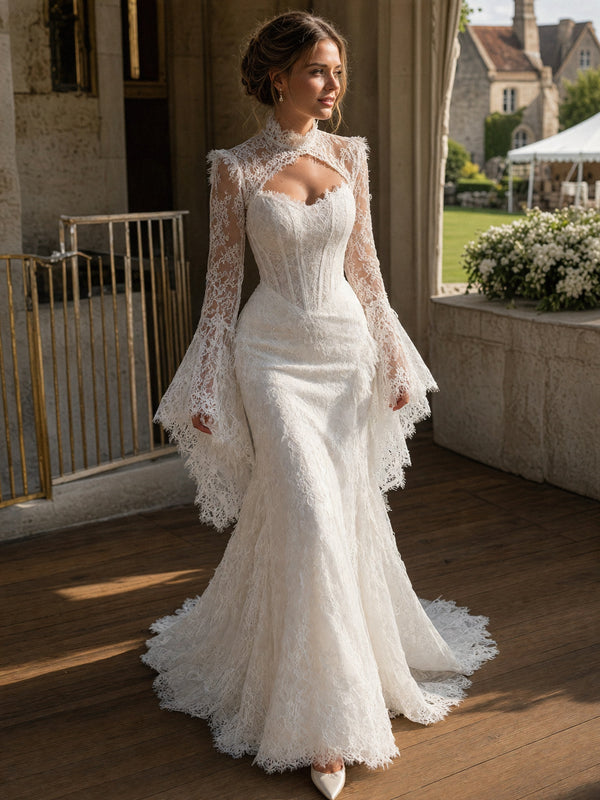
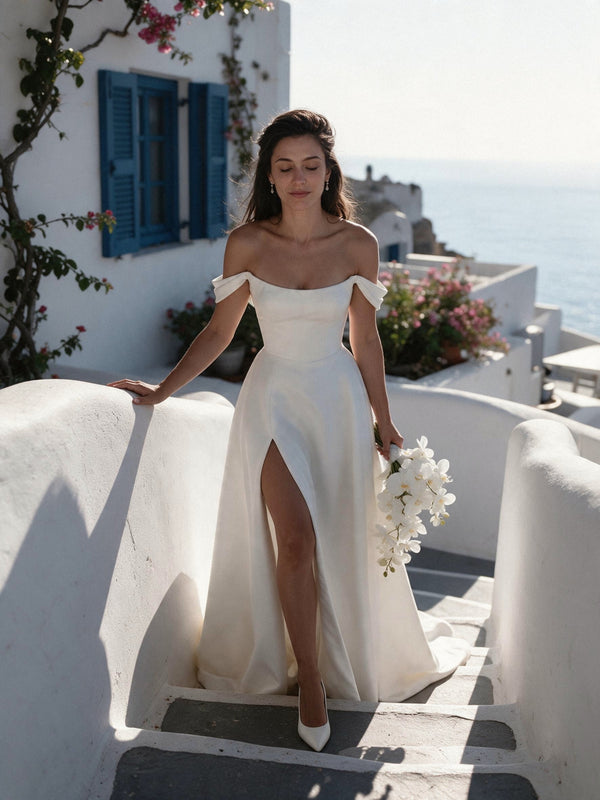
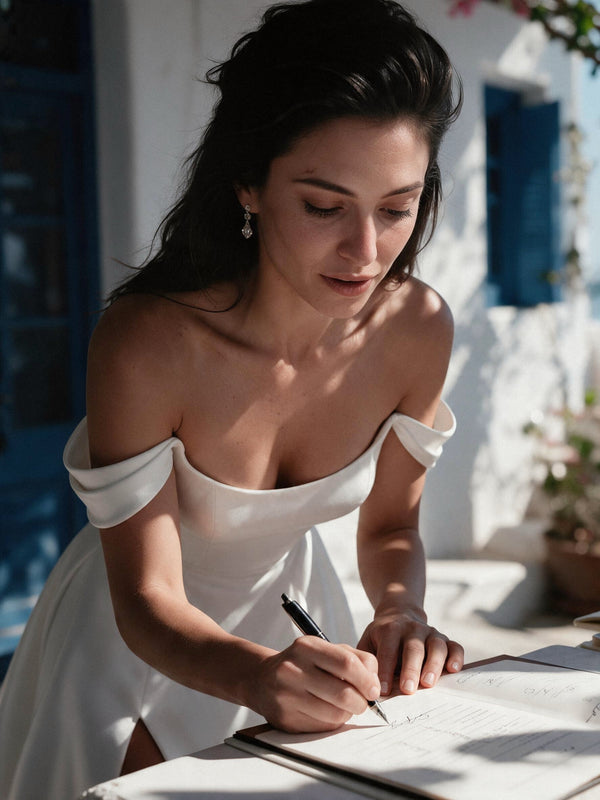
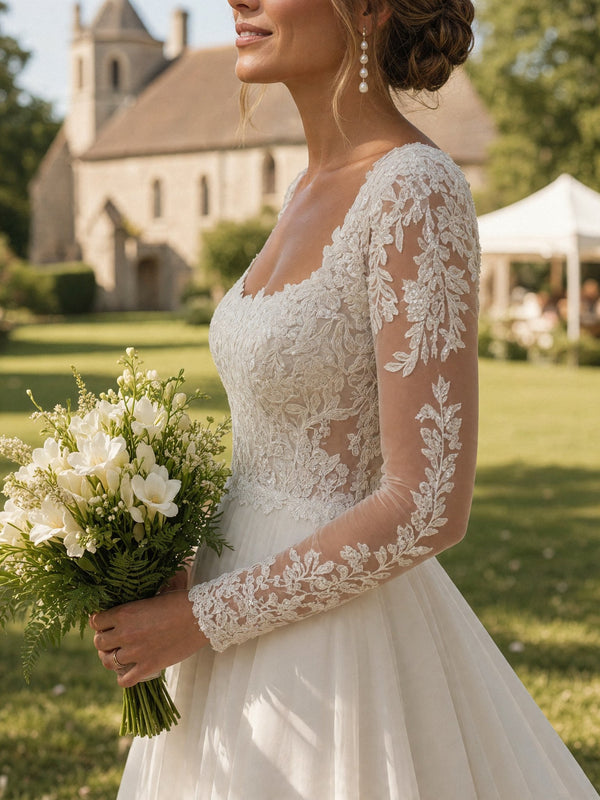
No lace, no embroidery, no crystals: only a cut and the light sliding across it. The satin wedding dress is the choice of brides who prefer presence to ornament. It looks simple; in fact it is the most demanding, because everything shows. Here is how to choose the right satin, the right cut, and keep it flawless from morning to night.
- Satin is a weave, not a fibre: it can be silk, polyester or a blend.
- Duchess and mikado are thick and structured; charmeuse and crepe-back satin are fluid.
- Heavy satin for ball gowns and winter, fluid satin for sheaths and summer.
- Seamless lingerie and a garment steamer: the satin bride's two best friends.
- What is satin?
- The four bridal satins
- Which cut for which satin
- Satin through the seasons
- Staying flawless all day
- Styling it without weighing it down
- Our selection
- Your questions
What is satin?
Satin is not a material, it is a way of weaving. The threads are crossed so that long threads float on the surface: that is what gives the smooth, glossy face and the matte back. It comes in silk, polyester or blends; the weave, more than the fibre, decides its weight, drape and shine.
That is why two "satin" dresses can have nothing in common: one stands up on its own, the other pours like water.
The four bridal satins
| Satin | The hand | The sheen | Best for |
|---|---|---|---|
| Duchess | Thick, firm, heavy | Luminous, deep | Ball gowns, corsets, winter weddings |
| Mikado | Thick, slight twill | Soft, almost matte | Architectural lines, crisp pleats, bows |
| Charmeuse | Light, slippery | Very glossy | Slip dresses, bias cuts, summer |
| Crepe-back satin | Supple, reversible | Satin on one side, matte on the other | Sheaths, draping, minimalist dresses |
If you love a matte, fluid finish but not the shine, look at crepe too, which shares many of satin's qualities. Our mermaid dress guide covers it, as it is one of that cut's favourite fabrics.
Which cut for which satin
Sheath and slip
A fluid satin that follows the body without gripping it. The 1990s look, very current.
A-line
A medium-weight satin and a skirt that flares without pleats: the easiest cut to wear.
Ball gown
A heavy satin that holds the volume and shows off the folds. Majestic in a church or a château.
Satin also lends itself to draping, portrait necklines, slits and sculpted bows, details that take the place of ornament. To compare every cut, see our guide to wedding dress silhouettes, and for the full-skirted dress, our ball gown guide.

Satin through the seasons
A heavy satin protects you from the cold and keeps its shape in a chilly church; in full summer sun, it can feel warm. Conversely, a light charmeuse is a joy in July but calls for a stole once night falls.
- Spring and autumn: every satin, with a preference for medium weights.
- Summer: fluid satin, bare shoulders, a slit or a tea length.
- Winter: duchess or mikado, long sleeves, and a cape for outdoors. See our guide what to wear over a wedding dress in autumn and winter.
Satin hides nothing: that is exactly why it is so beautiful when the cut is right.
Staying flawless all day
Satin has two weak points: it shows creases and it reveals what is underneath. Nothing serious, as long as you plan ahead.
- Hang the dress as soon as it arrives, on a wide hanger, away from sunlight.
- Steam it from the inside, never placing an iron on the face of the fabric.
- Wear seamless, skin-tone lingerie from the very first fitting.
- Keep a clean handkerchief handy: a drop of water can leave a mark on some satins.
In the car, sit on the back of the lifted skirt, or lay a white sheet on the seat: satin crushed under you for twenty minutes shows in every photo of your exit.
Satin also needs a precise fit, especially for sheaths. For reliable measurements, follow our guide on how to measure yourself.
Styling it without weighing it down
A satin dress is a blank canvas: one strong accessory is enough. A tulle veil with a cut edge extends the purity of the line; long gloves give a sleeveless dress a very couture feel; a pair of pearl earrings warms an open neckline. Avoid piling it on: the beauty of satin is the space around it. For the veil, our veil length guide helps you choose.
Our selection
Six satin dresses, from the minimalist sheath to the ball gown, made to your measurements or in your standard size.
 Bar-sur-AubeSatin, long sleeves, A-line, button backSee the dress →
 PupillinMinimalist satin, off the shoulder, slitSee the dress →
 MouffetardSatin sheath, draped strapsSee the dress →
 AvizeDraped satin, portrait neckline, high slitSee the dress →
 PomèguesChampagne satin, tea length, sweetheartSee the dress →
 Montigny-LencoupSatin ball gown, square neck, fitted sleevesSee the dress →
Your questions
Is satin suitable for a summer wedding?
Yes, if you choose a light, fluid satin (charmeuse, crepe-back satin) and an open cut: thin straps, bare shoulders, a slit. Heavy satins such as duchess are best kept for spring, autumn and winter.
Does a satin wedding dress show everything?
Glossy satin reveals underwear seams more than lace does. The fix: seamless skin-tone lingerie, light shapewear if you like, and a fitting wearing exactly those pieces.
How do you get creases out of a satin wedding dress?
Use a garment steamer, from the inside, held away from the fabric, never an iron directly on the face. Hang the dress as soon as it arrives, in a humid room if needed (a bathroom after a hot shower helps a lot).
What is the difference between satin and mikado?
Mikado is a thick fabric with a slight twill and a softer sheen: it holds architectural shapes. Duchess satin is smoother and more luminous. Both give a structured, couture look.
Which colour of satin should I choose?
Satin reflects light onto your face: ivory warms most skin tones, pure white suits very fair or very deep skin, champagne adds a golden touch. Our guide ivory, white or champagne helps you choose.
Which veil goes with a satin wedding dress?
A tulle veil with a cut edge, no lace, extends the purity of satin. For a sleeveless dress in winter, long satin gloves complete the line: see our guide how to wear bridal gloves.
More than one hundred and fifty satin wedding dresses, cut to your measurements.
See satin wedding dresses