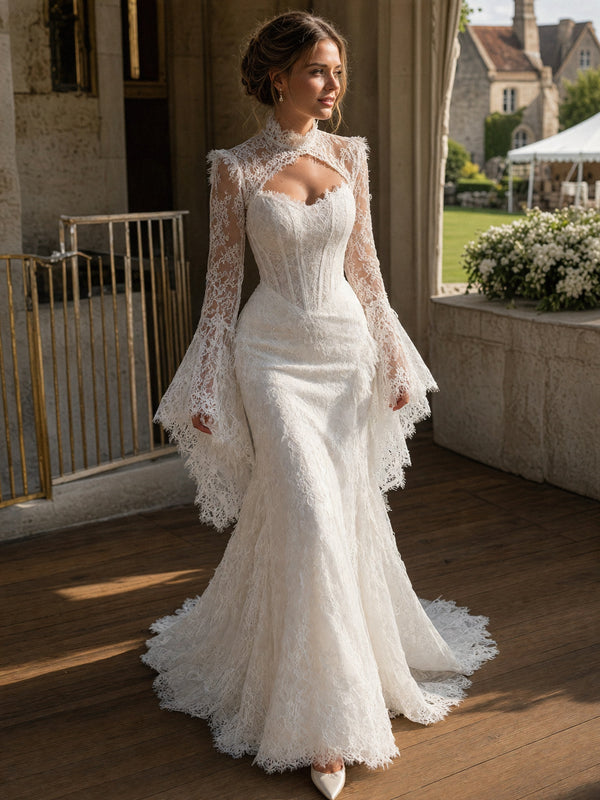
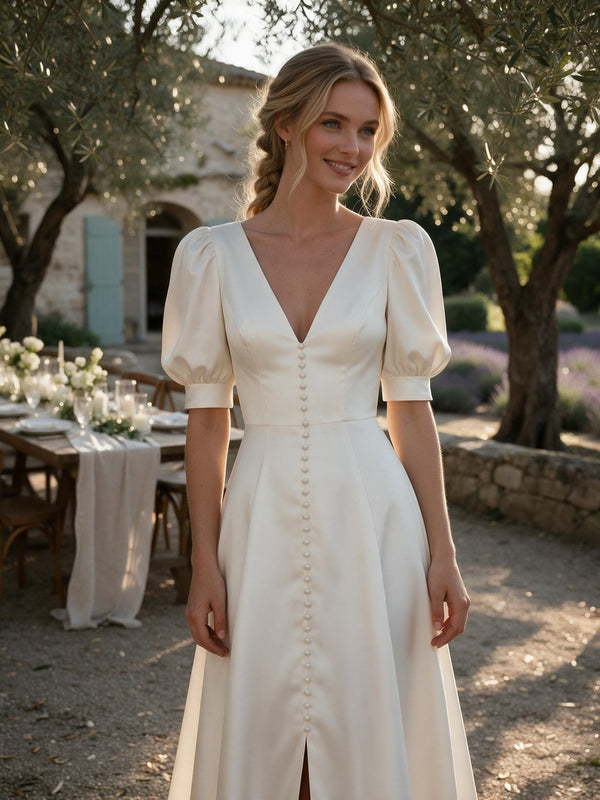
A vintage wedding dress borrows its line from another era: the high lace collar of a Victorian bride, the beaded column of the 1920s, the fitted bodice and full skirt of the 1950s. It is not a costume. Worn today, a vintage-inspired dress feels personal and timeless, and it photographs as well in fifty years as it does tomorrow. Here are the eras that shaped bridal fashion, the details that make a dress read vintage, and how to wear one without looking dressed up for a period film.
- Vintage-inspired means a new dress in the spirit of an era, cut to today’s measurements.
- Victorian: high collars, lace, long sleeves and buttons.
- 1920s: a straight column, beading and fringe. 1950s: a full skirt to mid-calf.
- Choose one era and keep the rest of the look modern.
- Vintage or vintage-inspired?
- The eras, decade by decade
- The details that make a dress vintage
- How to wear it today
- Fit, comfort and season
- Our selection
- Your questions
Vintage or vintage-inspired?
Strictly speaking, a vintage dress is an old dress: worn by a bride decades ago, found in a family trunk or a specialist shop. It is unique, but often fragile, rarely in your size, and sometimes yellowed. A vintage-inspired dress is new: it takes the silhouette and the details of an era, and is made in fresh fabric to your measurements.
Most brides who say "vintage" mean the second: the romance of another time, with the comfort, the fit and the white of a new dress.
The eras, decade by decade
| Era | The silhouette | Signature details | Wear it for |
|---|---|---|---|
| Victorian and Edwardian | A-line or full skirt, covered bodice | High lace collar, long sleeves, covered buttons, ruffles | A country church, a family house |
| 1920s | Straight column, dropped or no waist | Beading, fringe, Art Deco patterns | An evening party, a city wedding |
| 1930s | Bias-cut, close to the body | Satin, cowl necklines, low backs | A minimalist evening ceremony |
| 1950s | Fitted bodice, full skirt | Tea length, marked waist, cap sleeves | A town hall, a garden lunch |
| 1960s | Clean, structured lines | High round necks, short puff sleeves | A small, chic wedding |
| 1970s | Long and flowing | Bishop sleeves, high necks, soft lace | A garden or a country wedding |
For the 1930s slip, see our satin guide; for the softer 1970s line, our boho guide.
The details that make a dress vintage
A dress does not need to copy an era to feel vintage. Often a single period detail is enough, on an otherwise simple cut:
- A high lace collar or an illusion yoke.
- A long row of covered buttons down the back or the front.
- A tea-length skirt that shows the shoes.
- Lace cuffs at the end of long sleeves.
- A thin satin ribbon at the waist.
- A dropped V basque waist or a pleated corset.

How to wear it today
One era, not three
Pick a single period and let the dress speak. A Victorian collar with 1920s fringe and a 1950s veil turns into fancy dress.
Modern hair and make-up
A fresh complexion and soft, natural hair keep a period dress current. Save the finger waves for a 1920s column only if you love them.
Accessories with intent
Short gloves with a tea-length dress, a birdcage veil, pearl studs: one vintage accessory, the rest simple. See our gloves guide.
Fit, comfort and season
Period silhouettes were built on a precise fit: a marked waist, a fitted bodice, a sleeve that ends exactly at the wrist. That is why vintage-inspired dresses look their best made to measure. A tea-length dress is ideal from spring to autumn and for a civil ceremony; a high-necked lace gown with long sleeves is made for a church or a winter wedding.
With a fitted bodice and long sleeves, three measurements count above all: bust, waist and arm length. Our dresses are cut from your measurements; follow our guide on how to measure for a made-to-measure dress, and between two sizes, take the larger one.
For a city hall ceremony, our civil wedding guide has more ideas; for the cold months, our winter guide.
Our selection
Six vintage-inspired dresses, from a Victorian lace collar to a 1920s fringe column. All are made to your measurements or in your standard size.
 CumièresVictorian high collar, lace capelet, bishop sleevesSee the dress →
 ConcordeArt Deco column, beaded fringe, chevron sequinsSee the dress →
 OuvéaTea length, lace cap sleeves, ribbon beltSee the dress →
 LifouTea-length satin, high round neck, puff sleevesSee the dress →
 GaillonPleated corset, dropped V basque, ruffled skirtSee the dress →
 Place des VosgesButtoned front, lace cuffs, satin sashSee the dress →
Your questions
What is the difference between vintage and vintage-inspired?
A vintage dress is an old dress from a past decade. A vintage-inspired dress is new, made in the style of an era, in fresh fabric and to your measurements.
Which vintage era suits a petite bride?
The 1950s tea length and the 1960s clean lines suit petite figures well: they show the shoes and keep the proportions light. See our petite guide.
Is a vintage-style dress suitable for church?
Very much. Victorian and Edwardian styles, with high collars and long sleeves, cover the shoulders and arms by design.
What veil goes with a vintage wedding dress?
Match the era: a birdcage or a short veil with a 1950s tea length, a long lace-edged veil with a Victorian gown, a headpiece rather than a veil with a 1920s column.
Can a vintage-inspired dress be ivory?
Yes, and ivory often suits period styles better than bright white. Our guide to ivory, white and champagne helps you choose.
Is a tea-length dress formal enough for a wedding?
Yes. Tea length was the bridal length of the 1950s; with a full skirt and good shoes, it is as elegant for a church as for a town hall.