Being petite does not mean giving up on any dress. It means paying attention to proportion: where the waist sits, how far the neckline opens, how much volume the skirt carries, and above all how long the dress is with your heels on. Get those four right and almost every silhouette works. Here is the method, line by line.
- Petite usually means about 1.63 m (5 ft 4) or under.
- Vertical lines lengthen: V necklines, sheath and A-line skirts.
- A natural or basque waist lengthens the legs; a drop waist shortens them.
- The hem is cut to your hollow-to-floor measurement plus your heel.
- What petite really means
- The silhouettes that work
- Neckline and waist
- Length, hem and heels
- Train, fabric and details
- Our selection
- Your questions
What petite really means
In bridal, “petite” usually means a height of about 1.63 m (5 ft 4) or less. But two brides of the same height can have very different proportions: some have a short torso and long legs, others a long torso and shorter legs. Before choosing, look at where your natural waist sits: it tells you which waistline will rebalance the figure.
The silhouettes that work
| Silhouette | For petite brides | Why | Watch out for |
|---|---|---|---|
| A-line | Yes, the safest | Fitted bodice, skirt that flares gently: lengthens without weighing down | Very stiff, wide skirts |
| Sheath / column | Yes | One unbroken vertical line from neck to floor | A fabric that is too heavy |
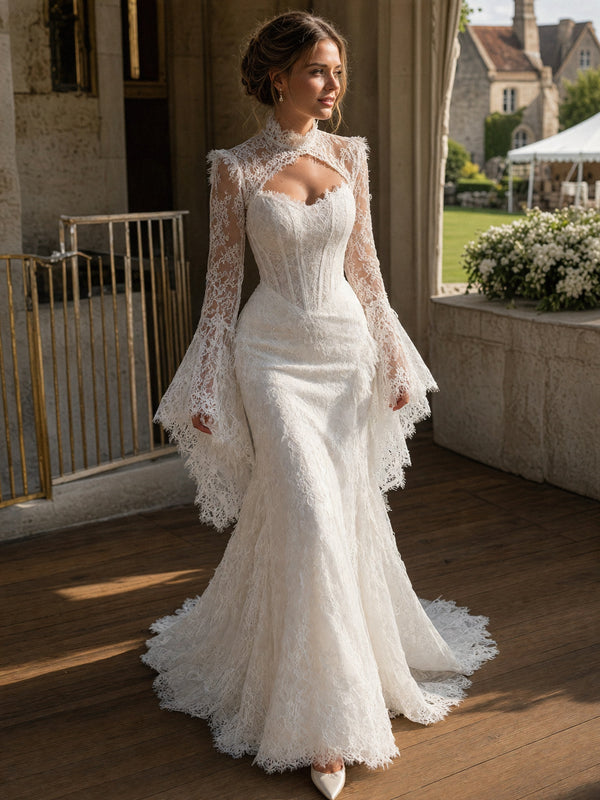
| Mermaid / trumpet | Yes, if well placed | Shows the curve; the flare should start at the knee, not lower | A flare set too low, which shortens the leg |
| Ball gown | Yes, kept light | Tulle or organza, a defined waist, a basque point | Heavy layers that swallow the figure |
| Short / tea length | Yes | Shows the legs, easy to wear | A hem that cuts the calf at its widest |
For each silhouette in detail, see our silhouettes guide, our A-line guide and our short dress guide.
Neckline and waist
The V neckline
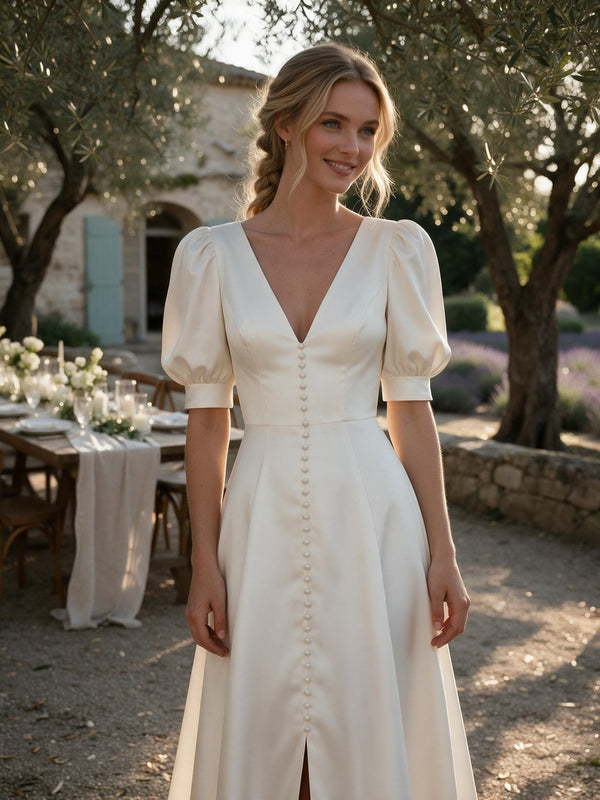
The most lengthening: it draws the eye down the neck and torso. Sweetheart and off the shoulder also work well.
The waist
A natural waist or a basque point lengthens the legs. Avoid drop waists, which shorten them.
The vertical line
Seams, pleats, a slit or a row of buttons drawn from top to bottom all make you look taller.
High necks are not forbidden: wear them with your hair up to free the neck. Our neckline guide and our guide to the wedding dress for your body shape go further.

Length, hem and heels
This is where petite brides lose the most with off-the-rack dresses: a dress cut for a taller sample size is shortened, and the lace border or scalloped hem is lost along the way. A dress cut to measure starts from your height instead.
- Measure from the hollow at the base of your neck to the floor, barefoot.
- Add the height of the heels you will wear on the day.
- Choose your shoes before you order: the hem depends on them.
- Platforms and block heels add height and stay comfortable all day.
- Nude or skin-tone shoes lengthen the line of the leg.
- With flats, the dress should just brush the floor, never drag.
In our size chart, the standard hollow-to-floor measurement starts at 147 cm. If yours is shorter, choose “Custom size” and enter your exact measurements and heel height: the dress is cut to them, so nothing is lost at the hem. Everything is explained in our guide on how to measure for a made-to-measure dress.
Train, fabric and details
Keep the drama, scale the details.
- Train: a sweep or chapel train is in proportion; a cathedral train can be worn if it is light, or detachable. See our train guide.
- Fabric: crepe, fluid satin, chiffon and light tulle move with you; stiff, heavy fabrics add width.
- Lace and beading: smaller motifs stay in scale. Dense embellishment looks best concentrated on the bodice.
- Veil: fingertip or chapel length, fixed high on the head to add height.
Our selection
Six dresses with clean vertical lines, light fabrics and well-placed waists. All are made to your measurements or in your standard size.
 Palais-RoyalDraped satin sheath, strapless, satin scarfSee the dress →
 PulignySatin A-line, plunging V, pleated waistSee the dress →
 AloxeChiffon A-line, square neck, bishop sleevesSee the dress →
 HonfleurCrepe mermaid, one shoulder, minimalistSee the dress →
 ErquyCrepe mermaid, high halter, open backSee the dress →
 MolèneShort tulle, lace corset, sheer puff sleevesSee the dress →
Your questions
Can a petite bride wear a ball gown?
Yes, if it stays light: tulle or organza rather than heavy layers, a well-defined waist, ideally a basque point, and a skirt that does not start too wide.
Which neckline makes you look taller?
The V neckline: it draws the eye down the neck and torso. Sweetheart and off-the-shoulder necklines also lengthen.
Should petite brides avoid mermaid dresses?
No. Choose a flare that starts at the knee rather than below it, in a fluid fabric such as crepe or satin.
How high should my heels be?
As high as you can comfortably wear all day. What matters most is choosing them before ordering, because the length of the dress depends on them.
Do I need alterations as a petite bride?
With a standard dress, often: the hem, the waist and the straps. With a dress cut to your measurements and heel height, far fewer, and the hem keeps its original finish.
Can I wear a long train if I am petite?
Yes, if it is light or detachable. A chapel train is the most balanced; a cathedral train works in a large church, bustled for the party.