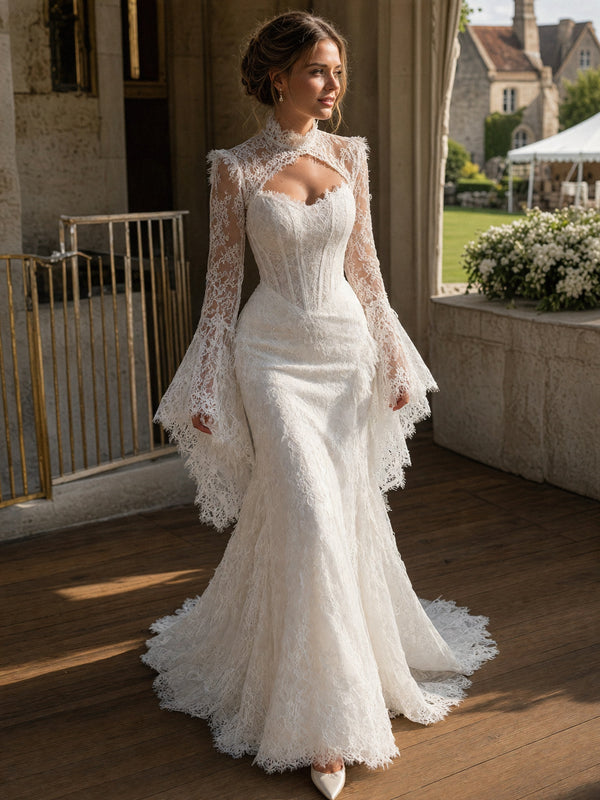
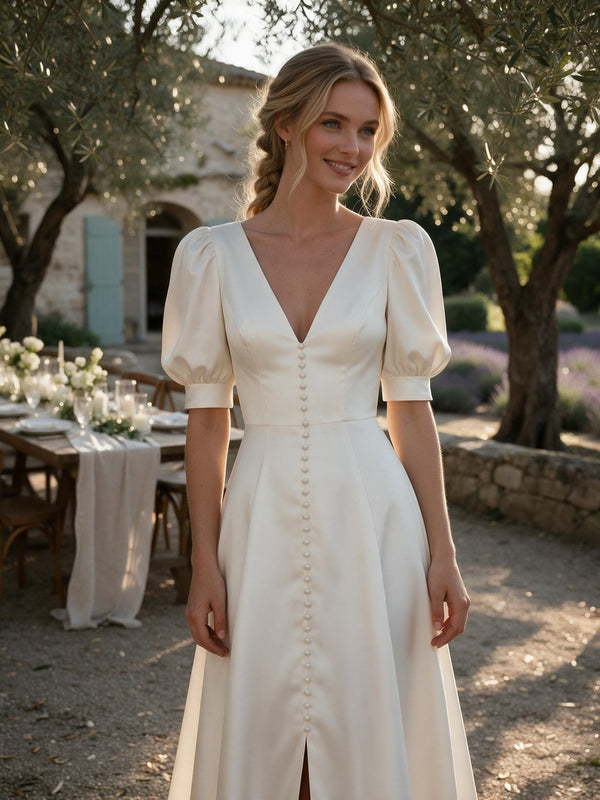
For a long time, the corset was the part of the wedding dress nobody saw. Today it is the dress. On the 2027 bridal runways, boning shows through sheer lace and tulle, waists dip into a pointed basque, and structured bodices are worn as the star of the look. A corset bodice is also simply practical: it holds itself, it shapes the waist and it keeps a strapless neckline exactly where it should be. Here is how it is built, how it should feel, and how to choose yours.
- A corset bodice is fitted and boned: it holds its shape on its own.
- A sheer corset shows its boning through lace or tulle, as a design.
- A basque waist dips into a V below the natural waist and lengthens the torso.
- A well-cut corset never hurts: it should let you sit, eat and dance.
- What makes a corset bodice
- The corset styles
- By figure
- Comfort, support and underwear
- What the 2027 runways show
- Our selection
- Your questions
What makes a corset bodice
A corset bodice is made of several fitted panels, stiffened with flexible bones sewn into the seams. The boning keeps the fabric smooth from the bust to the waist, stops a strapless neckline from slipping, and shapes the waist without any belt. It closes at the back with a lace-up, a zip, or a row of buttons, sometimes with a modesty panel behind the lacing.
The difference with an ordinary fitted bodice is the structure: a boned corset stays upright even off the body. That is what allows sheer versions, where the boning becomes a design line under transparent lace.
The corset styles
| Style | How it looks | What it does | Wear it for |
|---|---|---|---|
| Sheer corset | Boning visible under lace or tulle | Light, graphic, very current | A city wedding, an evening party |
| Satin corset | Smooth, sculpted, sometimes with cups | Clean structure, strong waist | A château, a minimalist look |
| Lace corset | Lace laid over a boned base | Romantic, textured | A church or garden wedding |
| Beaded corset | Pearls, crystals and sequins on the boning | Catches every light | A ballroom, a winter wedding |
| Basque waist | The bodice dips into a V below the waist | Lengthens the torso | Ball gowns and A-lines |
| Corset + cover | Detachable sleeves, bolero or cape | Two looks in one day | A ceremony that asks for covered arms |
A corset works with every neckline: straight strapless, sweetheart, plunging, off the shoulder. Our neckline guide explains what each one does.
By figure
Fuller bust
Choose a corset with structured cups and wider straps or an off-shoulder band: the support comes from the boning, not from a bra.
Straight figure
A basque waist and a full skirt create the curve; a lace-up back lets you tighten the waist a little more.
Petite
A basque or V waist lengthens the torso. Keep the skirt light rather than heavily layered. See our petite guide.

Comfort, support and underwear
A corset should hold you, not squeeze you. If it is cut to your measurements, you can breathe, sit at the table, eat and dance; the bones bend with you. What makes a corset uncomfortable is almost always a wrong size: too tight at the waist, too loose at the bust.
- Most boned bodices need no bra: the support is built in.
- Under a sheer corset, wear seamless nude underwear, or none.
- A lace-up back adjusts by a few centimetres, useful if your weight moves before the day.
- Sit down and raise your arms at the fitting: nothing should dig in.
- Take your measurements in the shoes and underwear you will wear.
- Plan a bolero or cape if the ceremony asks for covered shoulders.
A corset is a matter of centimetres. Our dresses are cut from your bust, waist and hip measurements: take them in the morning, without pulling the tape tight, following our guide on how to measure for a made-to-measure dress. Between two sizes, take the larger one: a lace-up back can always be tightened.
What the 2027 runways show
The corset is no longer underneath. It is the dress.
Across the latest bridal shows, the same ideas keep coming back: boning left visible through sheer fabric, waists that dip into a basque or drop lower, accentuated hips, oversized bows, and corsets that come with a second look, from detachable sleeves to removable overskirts. The corset is the thread that ties them together, because it is the part that makes all that volume and transparency possible.
For a sheer corset with a ball gown, see our ball gown guide; for a two-in-one dress, our two-in-one guide.
Our selection
Six corsets, from beaded and sheer to smooth satin. All are made to your measurements or in your standard size.
 GarnierBeaded boned corset, draped off-shoulder bandSee the dress →
 ValençaySatin corset, sculpted cups, basque waistSee the dress →
 GevreySheer beaded lace corset, flower strapsSee the dress →
 PuisseguinLeaf lace corset, plunging sweetheart, lace-up backSee the dress →
 CancaleSheer lace corset, crepe mermaid, plunging VSee the dress →
 MontsoreauBoned sweetheart corset, tulle, lace-up backSee the dress →
Your questions
Is a corset wedding dress comfortable?
Yes, if it is cut to your measurements. The bones bend with you: you can sit, eat and dance. Discomfort almost always comes from a corset that is too tight at the waist or too loose at the bust.
Do I need a bra under a corset dress?
Usually not: a boned bodice is built to support you. Under a sheer corset, choose seamless nude underwear or nothing at all.
Lace-up or zip back: which is better?
A lace-up back adjusts by a few centimetres and gives a couture look; a zip is quicker to close. Both hold just as well if the bodice is boned.
Does a corset suit a fuller figure?
Very much: the boning supports the bust and shapes the waist. Choose structured cups, wider straps or an off-shoulder band, and a skirt that flows from the waist.
What is a basque waist?
A waistline that dips into a V or a point below the natural waist. It lengthens the torso and makes a full skirt look even fuller.
Can I wear a sheer corset in church?
Yes, with a cover for the ceremony: a lace bolero, a cape or detachable sleeves, removed for the reception. See our church dress code guide.