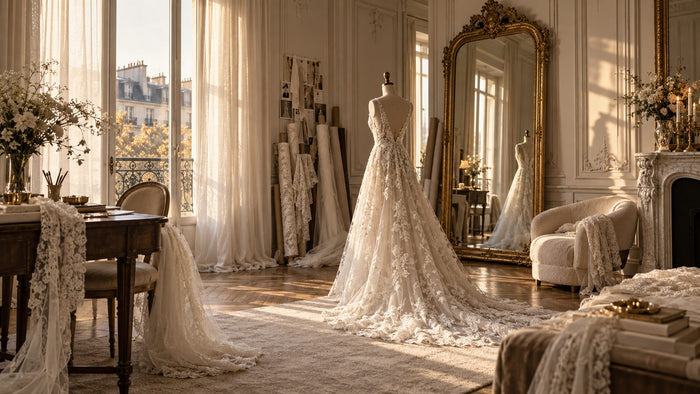

Most wedding traditions are older than anyone at the table, and a few are younger than you would think. Knowing where they come from makes it easier to choose: keep the ones that mean something to you, adapt the others, and leave the rest without a second thought. Here are the stories behind the customs you will meet on the day.
Something old, something new, something borrowed, something blue
The rhyme is English and Victorian. A version appears in print in 1871, and the full list of four is reported at a wedding in 1876. A fifth line came later, still in the Victorian era: "and a silver sixpence in her shoe", worn in the left shoe for prosperity.
- Something old ties the bride to her family and to what came before.
- Something new looks ahead: very often, it is the gown itself.
- Something borrowed, ideally from a happily married friend, lends a little of their luck.
- Something blue stood for faithfulness and purity.
Today it is the easiest tradition to make personal: a grandmother's veil or earrings for the old, a blue ribbon sewn inside the hem, a borrowed bracelet from your closest friend.
The white gown
For centuries, brides simply wore their best dress, in whatever colour they owned. White took over after one wedding in particular: Queen Victoria married Prince Albert on 10 February 1840 in a gown of cream-white silk satin woven in Spitalfields, trimmed with Honiton lace from Devon. She was not the first royal bride in white, but the portraits and engravings of her wedding travelled far, and within a decade white had become the fashionable choice among wealthy brides. It became the norm for everyone much later.
What she started was less a colour than an idea: a gown made for one day only. Ivory, champagne and white all belong to that idea today, and so does the lace.
The veil
In ancient Rome, a bride wore the flammeum, a veil whose colour writers of the time described as flame-like, somewhere between yellow-orange and red. It was part of the bridal headdress, and ancient authors linked it to protection and to modesty. The white veil came much later, alongside the white gown.
Today the veil is chosen for the line it draws rather than for what it hides: a fingertip veil for movement, a cathedral length for the walk down the aisle. Our guide to veil lengths shows each one with a gown.
The ring on the fourth finger of the left hand
The custom rests on a lovely mistake. Ancient writers, among them the Roman author Macrobius, spoke of a vein or nerve running straight from the fourth finger of the left hand to the heart. The name vena amoris, the vein of love, was put in print by an English lawyer, Henry Swinburne, in 1686. Anatomy has since shown that no such vein exists, but the finger kept its meaning, and in many countries the ring still goes there. In others, it is worn on the right hand: both are traditional.
The bouquet
Before it was about flowers, it was about scent. Brides in antiquity carried bundles of strong herbs, such as rosemary, believed to bring luck and keep bad spirits away. Flowers slowly took their place and gathered their own meanings, and the bouquet toss grew from the old belief that some of the bride's good fortune could be passed on: whoever catches it is said to marry next.
The wedding cake
The cake has been many things. In medieval England, small cakes were piled as high as possible, and the couple tried to kiss over the pile without knocking it down, a promise of a prosperous life together. By the seventeenth century there was a "bride's cake", a pale cake under white icing. The white icing stayed, and the idea of a tall, fully edible tiered cake is usually traced to a royal wedding in 1882, that of Prince Leopold, Duke of Albany.
What to keep, and how to make it yours
No tradition is compulsory, and the most memorable weddings often keep only three or four, done with care. A few ideas:
- Choose by meaning, not by habit. If a custom makes you smile when you read its story, keep it. If it feels like a chore, let it go.
- Bring family into the old and the borrowed: a veil, a brooch, a pair of gloves worn by someone you love.
- Let the gown be the new. A gown made to your measurements is, quite literally, the newest thing you will ever wear.
- Carry the same hand through everything. When the invitation, the gown and the table share one palette and one mood, every tradition you keep looks as if it belonged there from the start. That is the idea behind Vowery, by Serment Couture: invitations cut from the same cloth as the gowns.
Questions
Where does "something old, something new" come from?
It is an English Victorian rhyme. A version appears in print in 1871, the full list of four in 1876, and the line about a sixpence in the shoe was added later in the Victorian era.
Why do brides wear white?
White became fashionable after Queen Victoria's wedding on 10 February 1840, when she wore a cream-white silk satin gown trimmed with Honiton lace. Before that, most brides wore their best dress in any colour.
Why is the wedding ring worn on the fourth finger?
Because of an old belief in a "vein of love", the vena amoris, running from that finger to the heart. The vein does not exist, but the tradition stayed. In some countries the ring is worn on the right hand instead.


